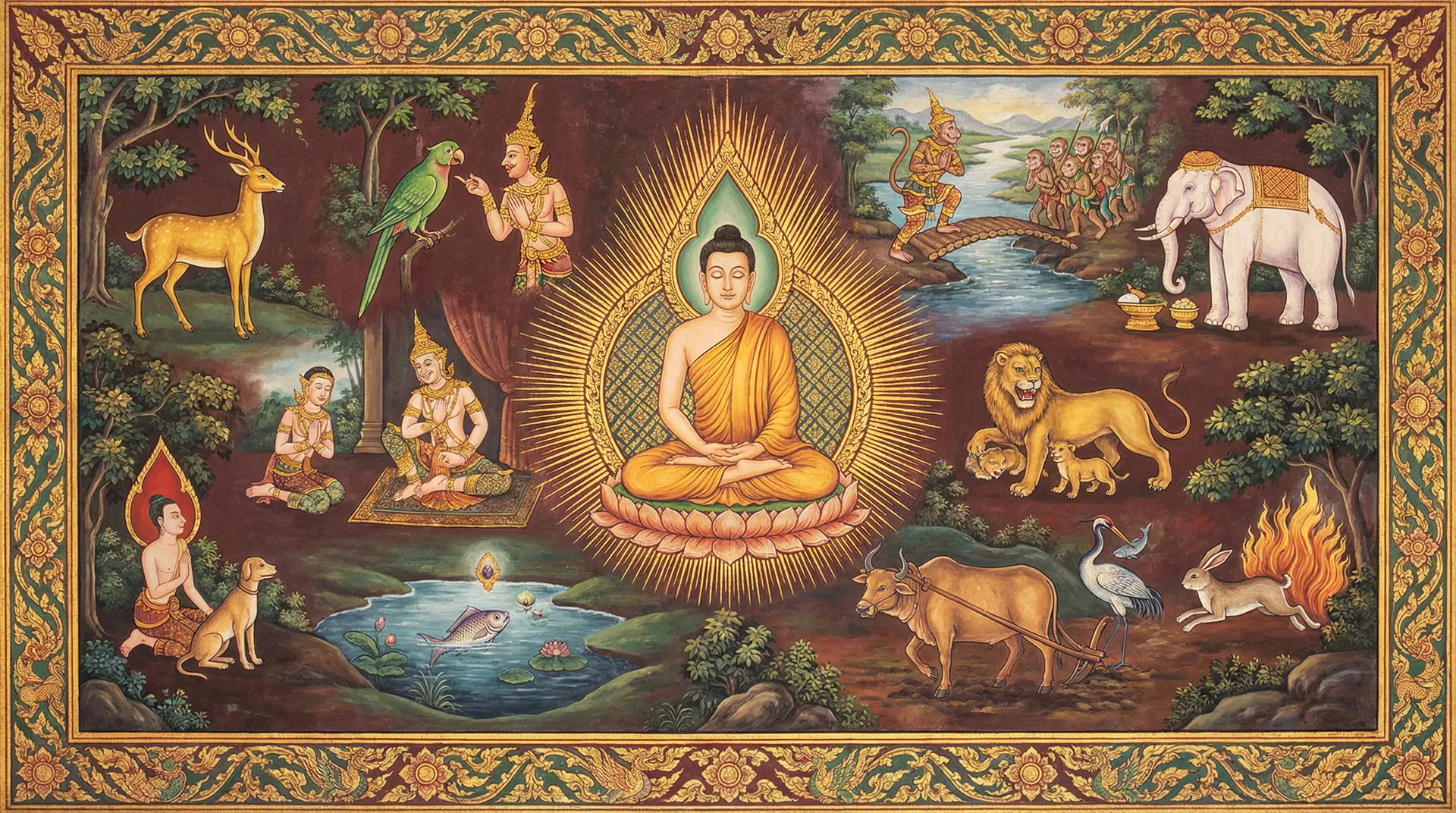
Sutasoma Jataka
Sutasoma Jataka
In the bustling city of Benares, lived a king named Sutasoma, a ruler whose heart was as vast as the ocean and whose courage was as unyielding as the Himalayas. He was a man of great virtue, devoted to the principles of dhamma, and his kingdom flourished under his benevolent rule. However, even the most virtuous hearts can be tested by the temptations of the world, and King Sutasoma was about to face such a trial.
One day, a fearsome ogress, named Surasa, who was known for her insatiable hunger for flesh, descended upon the kingdom. Her arrival cast a pall of terror over the land. She was a creature of immense power, her eyes burning with a malevolent fire, and her roar could shake the very foundations of the earth. She demanded a daily tribute of a young man, threatening to devour the entire populace if her demand was not met. The people, petrified, pleaded with their king to find a solution.
King Sutasoma, ever the protector of his subjects, was deeply troubled. He could not bear to see his people suffer, nor could he allow his kingdom to be consumed by fear. He summoned his wisest advisors, but their counsel offered no solace. "We cannot fight such a monstrous being, Your Majesty," they said with trembling voices. "Her power is beyond our reckoning." The king pondered this, his brow furrowed with concern. He knew that a direct confrontation would lead to bloodshed and despair.
Then, a thought, bold and selfless, bloomed in the king's mind. He remembered the ancient vows he had taken, vows of compassion and sacrifice for the sake of his people. He decided that he himself would confront the ogress. He adorned himself in his finest royal attire, his heart filled with a quiet resolve. He rode out of the city gates, alone, towards the dark forest where Surasa was said to dwell.
As he entered the shadowed woods, the air grew cold, and an eerie silence fell. Suddenly, a monstrous form emerged from the trees, its eyes fixed on the king. It was Surasa, her fangs bared in a terrifying grin. "So, the king himself comes to offer himself as my meal!" she cackled, her voice like the grinding of stones. "You are a brave fool, King Sutasoma!"
King Sutasoma, with a calm voice, replied, "O Surasa, I have come not to fight you, but to understand you. Your hunger is great, I see. But tell me, what is it that you truly seek? Is it flesh alone that satisfies you, or is there something deeper that you crave?" The ogress, taken aback by his unexpected question, paused. No one had ever spoken to her with such a lack of fear, let alone with curiosity.
"I seek sustenance," Surasa growled, "for I am always hungry. But even sustenance does not fill the emptiness within me." King Sutasoma, seeing a flicker of vulnerability in the ogress's fierce demeanor, pressed on. "Perhaps," he said gently, "your hunger is not for flesh, but for kindness, for understanding, for a recognition of your own existence. I offer you not my flesh, but my compassion. I offer you my time, to listen to your story, to understand the source of your suffering."
Surasa, hearing these words, felt a strange sensation. It was as if a long-dormant ember within her heart was beginning to glow. She had been feared, reviled, and hunted for centuries. No one had ever offered her kindness. Hesitantly, she began to speak of her loneliness, her pain, her ostracization from the world. As she spoke, King Sutasoma listened with unwavering attention, his heart filled with empathy. He did not judge her; he simply acknowledged her pain.
When Surasa had finished, tears, hot and heavy, streamed down her monstrous face. She looked at King Sutasoma, not with hunger, but with a newfound respect. "King Sutasoma," she whispered, her voice thick with emotion, "you have shown me a kindness I never thought possible. I have taken so much life, but you have given me something more precious: understanding. I can no longer bear to inflict suffering." With that, Surasa, the fearsome ogress, transformed. Her monstrous form softened, her eyes lost their malevolent glow, and she became a gentle creature, no longer driven by insatiable hunger. She vowed to protect the forest and its inhabitants, and King Sutasoma returned to his kingdom, not with a trophy of battle, but with the profound victory of compassion.
— In-Article Ad —
💡Moral of the Story
True victory is not achieved through violence, but through understanding, compassion, and the transformation of negativity.
Perfection: Compassion (Karuna)
— Ad Space (728x90) —
More Jataka Tales You May Enjoy
 74Ekanipāta
The Tale of the Sword
In the prosperous Kosala kingdom, within the renowned city of Savatthi, where King Pasenadi, the rig...
💡 True strength lies in collective effort, resourcefulness, and perseverance, not in mythical solutions.
61EkanipātaThe Tale of the Self-Sacrificing Crane
The Tale of the Self-Sacrificing Crane In the ancient kingdom of Mithila, nestled amidst verdant pl...
💡 Past actions have consequences in the present, and even in times of suffering, one can help others with compassion.
24EkanipātaThe Bodhisatta as a King
The Bodhisatta as a KingIn the heart of a prosperous and fertile kingdom, known for its bountiful ha...
💡 True leadership inspires generosity, and collective compassion can overcome dire hardships.
 298Tikanipāta
Samkicca Jataka
The Samkicca Jataka: The Virtuous Gardener In the bustling city of Varanasi, known for its vibrant m...
💡 True happiness is found not in accumulating possessions, but in the act of selfless giving. Generosity purifies the heart, liberates us from attachment, and creates a profound and lasting sense of contentment.
113EkanipātaMahāgovinda Sutta Jātaka
Mahāgovinda Sutta Jātaka In the opulent city of Varanasi, a kingdom blessed with peace and prosperit...
💡 True wisdom lies in maintaining balance and equanimity in the face of both pleasure and adversity. Integrity and unwavering loyalty are the foundations of trust.
 191Dukanipāta
Kaccapajataka
Kaccapajataka In the ancient kingdom of Mithila, where palaces shimmered like lotus blossoms and riv...
💡 True wealth lies not in what we possess, but in our ability to be content with what we have. Greed is a bottomless pit that can never be filled.
— Multiplex Ad —